Free Value Perception Drill
Value practice that measures you. Six short tasks ask for the value of a grey, a colour or a spot in a painting on the 1 to 10 scale, and each answer comes back with its direction: too light or too dark, and by how much. Over sessions it shows where you lean. Exports CSV. Free, with no sign-up, and it runs in your browser.
All six tasks, mixed. Each answer is scored on the 1 to 10 value scale, 1 black and 10 white, and you are told which way you were out. Nothing is uploaded.
Before you start: set the screen to its normal brightness, turn off night mode and any warm tint, and look at it straight on. A grey is only as true as the screen showing it, and the darkest steps differ most between screens.
A lean is called once a group has 5 answers: darks, mid values, lights, each surround and each hue family. Sessions add up here.
Signed errors.Every answer is scored as too light or too dark, in value steps, not only as right or wrong.
Your lean, by zone.Darks, mid values and lights are counted apart, and so is each surround and each hue family.
Six tasks.A plain grey, a grey on a pulling ground, a spot in a painting, a ranking, a pair, and a saturated colour.
Repeatable.A session code brings the same session back, on any device. Nothing is uploaded.
- Free
- No sign-up
- Runs entirely in your browser
What is value practice?
Value practice is training the eye to judge how light or dark something is, apart from its colour. An artist names the value of a grey, a colour or a spot in a scene on a scale from black to white, checks the answer against a measurement, and repeats until the judgement is reliable.
How to use the Value Perception Drill
The tool takes 6 steps, all on your device.
Choose which Tasks to include and how many Answers in a session: 10, 20 or 30.
Set your screen to its normal brightness and turn off night mode.
Choose Start session.
For a patch, a colour or a circled spot in a picture, move the slider to its value from 1, black, to 10, white, and choose Answer.
For Rank five, press the patches from darkest to lightest. For Which is lighter, choose Left or Right.
Choose Next after each answer, and at the end read Which way you lean.
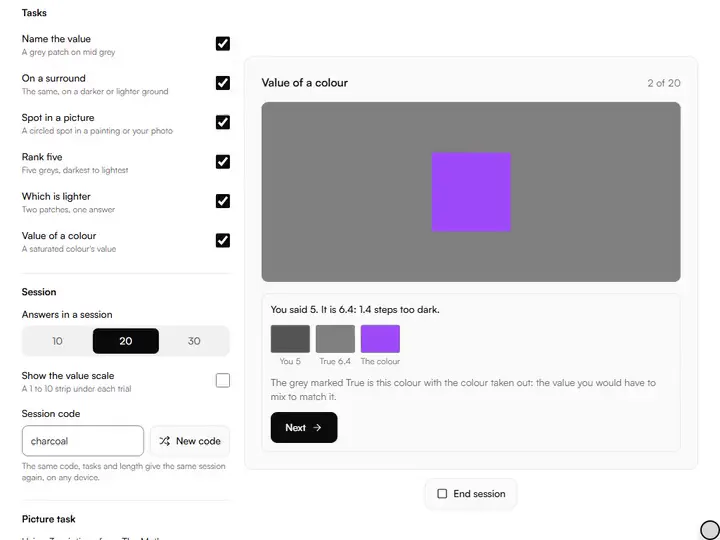
What the Value Perception Drill does
The Value Perception Drill measures your own judgement of value: the surround trap, colour's value, and spots in real paintings.
A measurement of you
Among the drawing practice tools, this is the one that asks first, measures the answer and tells you which way your eye is out.
The surround trap
A grey on a dark ground looks lighter than the same grey on a light one. The Surround task drills exactly that.
Colour's value
The Colour task shows a saturated colour and asks for the value under it.
Spots in real paintings
A circled spot in a Bruegel, a Vermeer or a Van Gogh, or in a photo of your own that never leaves your device.
With or without the scale
Show a 1 to 10 strip while you answer, or hide it and answer from memory.
History on your device
Each session's average error is charted, and the history exports as a spreadsheet file.
How it compares with other value practice tools
Each was used in a browser on 2 October 2026. Only what was seen is stated.
| Feature | This tool | Value Vision Trainer | Value Studies Coach | Proko Value Study Tool |
|---|---|---|---|---|
| Takes an answer and scores it | Yes | Yes | No | No |
| What the feedback said | “1.5 steps too light” | “You're off by 50 steps” and a running score | None: a timed study from a reference | None: a value view of your image |
| Lean by darks, mids, lights, surround and hue | Yes | No | No | No |
| Kinds of task | Six | One: a box in your image | Timed studies | A viewer |
| Your photo stays on your device | Yes | Sent to its server | Not tested | Not tested |
| Other servers the page contacted | None | 9 | 9 | 12 |
Value Studies Coach and Proko's tool show a reference in a few tones to make a value study from, which this drill does not do.
For anyone learning to see values
Painters, drawing students and teachers drill the eye to see values.
Painters
Find out whether your shadows run too dark before a whole painting tells you.
Drawing students
A value exercise for artists that gives a number to bring down.
Teachers
Give a class one session code and everyone answers the same twenty trials.
A value drill that keeps the sign of the error
An answer of 6.5 for a value of 5 is one and a half steps out. It is also one and a half steps too light, and that second fact is the useful one: a painter who reads every dark a step too dark can correct that habit on the palette tomorrow.
So each answer is scored as your answer minus the true value. At the end of a session the page gives the average size of your errors and, beside it, the average with its direction kept.
The six tasks
Name the value shows a grey patch on mid grey. On a surround puts it on a ground at least two steps darker or lighter. Spot in a picture circles a place in a painting or in your own photo. Value of a colour shows a saturated red, orange, yellow, green, blue or violet. All four are answered with the slider, in half steps.
Rank five shows five greys to press from darkest to lightest; the score is the number of pairs left in the wrong order. Which is lighter shows two greys on different grounds, or two saturated colours of different hues.
The simultaneous contrast lab shows what a ground does to any colour you choose; this drill tests whether you can read through it.
How the true value is measured
Value runs from 1, black, to 10, white. It is read from the colour's lightness in the OKLab colour space, the same measure the value checker uses, and always from the colour the screen is showing. For a picture it is the average inside the circle; the drill looks for a place close to one flat value, and says so where brushwork leaves none.
No patch is darker than value 2. Below that, the steps of this scale are greys that most screens show as the same black, and scoring you on them would be scoring your monitor.
When the drill calls a lean
Answers are grouped: darks are values 1 to 4, mid values 4.5 to 6.5, lights 7 to 10; then a darker and a lighter surround; then each hue family. A group gets a sentence such as “You read darks 1.2 steps too dark” only when it has five answers or more, its average is a quarter step or more, and that average is at least twice its own standard error. Otherwise the page says there is no clear lean, or that it is too early to say.
That rule is this tool's own, and cautious on purpose. One session rarely fills every group, so the first screen pools your last ten.
Your screen is part of the test
A grey is only as true as the screen showing it. Night mode, a warm tint, a dimmed laptop and a steep viewing angle all move the darks, and the drill cannot see your screen to correct for them. Use normal brightness and look straight on.
Then test the habit on paper: the value study maker turns a reference into a few flat values.
What it leaves out
The drill has no levels, lives, badges or leaderboards: the only score is your error. It does not judge a painting, and it puts no clock on an answer. The picture task uses one photo of yours, or three paintings: The Harvesters by Pieter Bruegel the Elder, Young Woman with a Water Pitcher by Johannes Vermeer and Wheat Field with Cypresses by Vincent van Gogh, all in The Metropolitan Museum of Art and marked public domain in its open-access records. History stays in this browser, up to 200 sessions; clearing site data removes it, so export it to keep it.
Further reading
The page below goes further into the ideas the Value Perception Drill works with, and opens on the site named beside it.
- Drawing and painting lessons on Artistic Masterclass (ArtisticMasterclass.com)
Tips from a working artist
From Sujith Puthran, artist and founder: what I actually do at the easel.
I squint at the patch before I move the slider. The first read with my eyes half closed is usually nearer than the one I argue myself into.
I hide the scale. At the easel nobody hands me a strip, and the drill only transfers if I answer from memory.
Questions about the Value Perception Drill
The 5 questions below cover the test itself, better seeing and saturated colour, then your data and the practice log.
The drill
Is this a tonal value test?
Yes, it works as a tonal value test: the result is your average error in value steps and the direction you lean. There is no pass mark.
How do I see values better?
To see values better, squint, compare each area with its neighbours and with the lightest and darkest things in view, and check your guesses against a measurement. This drill supplies the measurement.
Why is a saturated colour so hard to judge?
A saturated colour is so hard to judge because strong colour draws the eye and reads as brightness. A saturated blue can be far darker than it looks, and a saturated yellow is always a light value.
Your data
Does the Value Perception Drill upload anything?
No, the Value Perception Drill does not upload anything. The patches are made in the page, a photo of yours is read on your device, and the page contacts no other server.
Can the drill add to my practice log?
Yes, once you turn on Add sessions to my practice log. Each finished session is then written to the log on this device with its time and result. It is off until you turn it on.
- Pictures, value scale: metmuseum.github.io · checked 2026-10-02
- Pictures, value scale: collectionapi.metmuseum.org/public/collection/v1/objects/435809 · checked 2026-10-02
- Pictures, value scale: metmuseum.org/art/collection/search/435809 · checked 2026-10-02
- Pictures, value scale: collectionapi.metmuseum.org/public/collection/v1/objects/437881 · checked 2026-10-02
- Pictures, value scale: metmuseum.org/art/collection/search/437881 · checked 2026-10-02
- Pictures, value scale: collectionapi.metmuseum.org/public/collection/v1/objects/436535 · checked 2026-10-02
- Pictures, value scale: metmuseum.org/art/collection/search/436535 · checked 2026-10-02
Twenty answers, and a sentence each about your darks, your mid values and your lights.
Free · No sign-up · Runs in your browser