Free Classical Figure Reference Sessions
Figure drawing reference from the museum: antique sculpture, anatomy studies, drapery, hands and feet, and old-master figure drawings, each with its credit and a link to its museum page. Run quick studies, a long pose in sittings or a cast drawing in stages, with lenses for greyscale, squint, values and notan. Free, with no sign-up, and it runs in your browser.
30 min of drawing from 6 works, beginning with the one you choose. Every picture is kept on this site, with its credit and a link to its museum page. Nothing is uploaded.

Aphrodite Torso
Unknown maker, c. 200–1 BCE
Thasian marble
Unknown maker, Aphrodite Torso, c. 200–1 BCE. The Cleveland Museum of Art, John L. Severance Fund. CC0. View at the museum
Marked CC0 by the museum’s own open-access service on 2026-10-02.
To turn the muscles and bones in the round, see 3D Anatomy Pro.
Works chosen one by one.Sculpture, anatomy, drapery, hands and feet, and figure drawings, chosen one by one and kept on this site.
Credited and free to use.Every work is marked CC0 by its museum's own open-access service, and shown with its credit line and museum page.
Plans for long study.A long pose in three sittings, a cast drawing in four stages, or quick and sustained studies.
Study lenses.Greyscale, squint, three or five values, notan, and flip, on the work while you draw.
- Free
- No sign-up
- Runs entirely in your browser
What is figure drawing reference?
Figure drawing reference is any picture of the human figure that an artist draws from when no model is in the room: a photograph, a sculpture, a cast, or a drawing by an earlier artist. Sculpture and master drawings suit long study, because the pose never tires and the forms have already been made clear.
How to use the Classical Figure Reference Sessions
The tool takes 6 steps, all on your device.
Choose a Group, or leave it at Every group. Turn on Class-safe only for sculpture and clothed figures.
Choose the work to begin with by pressing its small picture.
Choose a Plan: Quick studies, Sustained studies, Long pose or Cast drawing, and the Drawing time.
Choose a lens under Look at the work if you want the picture in greyscale, blurred, in three or five values, or as a notan.
Choose Start session and draw until the chime. Pause, or choose Next step, at any time.
At the end, choose Copy the credits to keep the maker, museum and page of each work you drew.
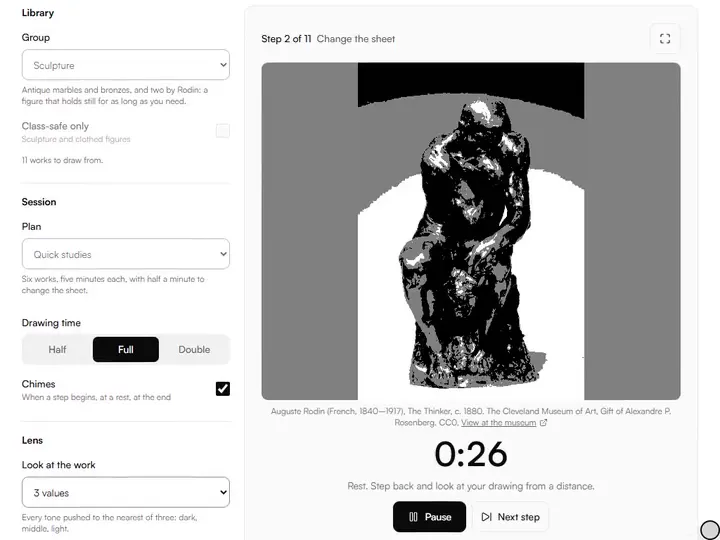
What the Classical Figure Reference Sessions does
Classical Figure Reference Sessions times figure reference that holds still, class-safe at a switch, with anatomy on paper and credits to take away.
Figure reference that holds still
Among the drawing practice tools, this one draws from the museum. A marble does not shift its weight in the fortieth minute.
Class-safe at a switch
Sculpture and clothed figures only, for a room where drawings of the unclothed model are not wanted.
Anatomy on paper
A flayed figure and skeleton studies from the 1500s, and a drawing of an anatomical cast.
Time that holds
The clock is read off the real time, so a tab left in the background comes back to the right stage and second.
For the easel
Full screen, a screen that stays awake, chimes at each stage and rest, and Pause within reach.
Credits to take with you
Copy the maker, title, museum and page of every work you drew, ready to put beside your study.
How it compares with other figure reference tools
Each was used in a browser on 2 October 2026. Only what was seen is stated.
| Feature | This tool | Line of Action | Quickposes |
|---|---|---|---|
| What you draw from | Museum sculpture, anatomy studies and master drawings | Photographs of models | Photographs of models |
| A credit and a source page under each picture | Yes | Not seen | Not seen |
| Covered figures only | Class-safe: sculpture and clothed | Only covered models | Clothes and costumes |
| Time on one picture | 2.5 minutes to 2 hours | 30 seconds to 10 minutes, and a class mode | 30 seconds to 5 minutes, or custom |
| A cast drawing in named stages | Yes | Not seen | Not seen |
| Greyscale, squint, values and notan on the picture | Yes | Not seen | Not seen |
| Other servers the page contacted | None | 17 | 7 |
Both have far larger libraries, of living models, and Line of Action sorts its models by age and gender as well. Line of Action's class mode and Proko's timer, which draws on photo packs, were opened and not tried.
For anyone studying the figure
Atelier students, teachers and self-taught artists study the figure from museum works.
Atelier students
Run a cast drawing in stages when there is no cast to hand, or a long pose that needs no model fee.
Teachers
Put a marble torso on the projector with Class-safe only on, and let the chimes run the stages.
Self-taught artists
Copy a hand by Ingres or an arm by Dürer, with the work's credit to hand.
Figure studies from the museum, kept on this site
The library is small and chosen by hand. Each work comes from the Cleveland Museum of Art's Open Access collection, and each was checked against the museum's own service on the day the set was built: a work is in the set only if that service marked it CC0. The pictures are kept on this site, so they load from here and nothing is asked of the museum while you draw.
Under every picture is its credit: the maker, the title, the date, the museum and its credit line, with a link to the museum's own page, where the full-size image and the full record are.
The five groups
Sculpture holds antique marbles and bronzes, torsos and whole figures, and two bronzes by Rodin. Anatomy has a flayed figure, skeleton studies by Battista Franco and a drawing by Cezanne of an anatomical cast. Drapery has studies on paper and two draped marbles. Hands and feet has studies by Dürer, Ingres and others. Figure drawings are studies from the model, from Perugino in the 1490s to Degas around 1900.
For muscles and bones you can turn in the round, the sister site 3D Anatomy Pro has models; this page keeps to works of art.
Plans: from five minutes to an hour
Quick studies puts six works in front of you for five minutes each. Sustained studies gives three works twenty minutes each. Long pose keeps one work for three sittings of twenty minutes with five-minute rests. Cast drawing keeps one work for an hour in four stages: the envelope and its big angles, the shadow shapes, the values, the edges, with a rest half way. Drawing time can be halved or doubled; the rests stay as they are.
The stage names are this tool's own plan, a common order of work and not a rule. For short poses from your own photographs, use the gesture drawing timer.
Lenses for figure studies
A lens changes how the work is shown, not the work. Greyscale takes the colour out of a bronze or a sheet of tinted paper. Squint blurs the picture so the detail goes and the big shapes stay. Three values and five values push every tone to the nearest step, which is the question a block-in has to answer. Notan leaves two tones only. Flip turns the picture left for right, which shows a lean you had stopped seeing.
What it leaves out
It has no photographs of living models and no poses in motion: for those, use your own pictures in the gesture drawing timer. The library is one museum's works and a few dozen of them. It does not measure your drawing; the drawing accuracy checker does that from a photo. The class-safe switch goes by what a work shows, as judged when the set was put together, and it keeps sculpture in.
Further reading
The page below goes further into the ideas the Classical Figure Reference Sessions works with, and opens on the site named beside it.
- Drawing and painting lessons on Artistic Masterclass (ArtisticMasterclass.com)
Tips from a working artist
From Sujith Puthran, artist and founder: what I actually do at the easel.
I draw a marble torso before I draw a person. It lets me be slow about the big tilt of the ribcage against the hips, and that is the thing I get wrong when a model is waiting.
I keep the squint lens on for the first ten minutes of a cast drawing and turn it off only when the shadow shape is one clean line.
Questions about the Classical Figure Reference Sessions
The 6 questions below cover where the pictures come from and their use for classes, anatomy and gesture, then sessions and privacy.
The library
Where do the pictures come from?
The pictures come from the Cleveland Museum of Art's Open Access collection. Each work was marked CC0 by the museum's own service on the day the set was built, and each is shown with its credit and a link to its museum page.
Can I use these as figure drawing reference poses for a class?
Yes, you can use these as figure drawing reference poses for a class. Turn on Class-safe only: the session then draws on sculpture and clothed figures and leaves out drawings of the unclothed model.
Is there anatomy reference for artists here?
Yes, there is anatomy reference for artists here, in the Anatomy group: a flayed figure, skeleton studies and a drawing of an anatomical cast.
Can I use it as gesture drawing reference?
Yes, partly: you can use it as gesture drawing reference for longer gestures, since Quick studies gives five minutes a work, or two and a half with Drawing time at Half. For shorter poses, the gesture drawing timer runs your own pictures from thirty seconds.
Sessions and privacy
What happens if I switch to another tab?
If you switch to another tab, nothing is lost: the clock is read off the real time, so the session is at the right stage and second when you come back. Chimes are set ahead when the session starts.
Does the Classical Figure Reference Sessions upload anything?
No, the Classical Figure Reference Sessions does not upload anything. The pictures are on this site, the session runs in your browser, and the page contacts no other server.
- The study set, a retired API: openaccess-api.clevelandart.org/api/artworks/{id} · checked 2026-10-02
- The study set, a retired API: clevelandart.org/open-access · checked 2026-10-02
- The study set, a retired API: collectionapi.metmuseum.org/public/collection/v1/search · checked 2026-10-02
Sculpture and master drawings from the museum, with a plan, a clock and a credit under every one.
Free · No sign-up · Runs in your browser