Free Color Mixing Drill
Color mixing practice with named paints. You are shown a color and mix it by parts from a Zorn palette, a split-primary palette or your own tubes. Each mix is scored by color difference and told which way it is out: too light, too cool, too grey. Exports CSV. Free, with no sign-up, and it runs in your browser.
You are shown a color and mix it from the Zorn palette by parts. The paint is mixed as pigment, not as light, and each answer comes back with its color difference and its direction: too light, too cool, too grey. Nothing is uploaded.
A lean in value, temperature or intensity is called from 5 mixes. Sessions add up here.
Paint, not light.Mixes are worked out as pigment, so a yellow and a blue make a green, not a grey.
Told which way.Every mix is scored and described: too light or dark, too warm or cool, too intense or grey.
Your own tubes.Drill with a Zorn palette, a split-primary palette, or the paints you have ticked as yours.
Blind or shown.Watch your mix change as you add paint, or hide it and mix from what you know.
- Free
- No sign-up
- Runs entirely in your browser
What is color mixing practice?
Color mixing practice is the habit of matching a color in front of you with the paints you have, then checking how close the mix came. Done as a drill, it teaches what each tube does to a mixture: how much white a color can take, what cools it, and what greys it.
How to use the Color Mixing Drill
The tool takes 6 steps, all on your device.
Choose a Palette: Zorn, Split primary, or Paints I own.
Choose where Targets come from: the palette itself, paintings, or your own photo.
Turn on Mix blind if you want your mix hidden until you answer.
Choose Start session, then add parts of each paint with the plus and minus buttons.
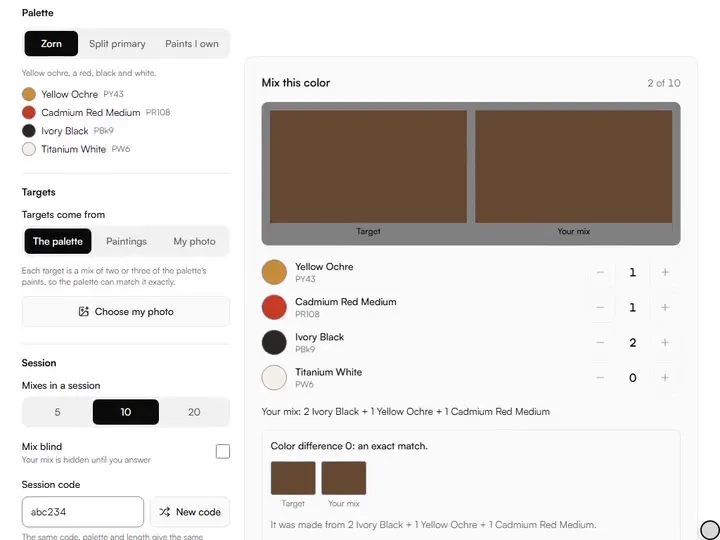
Choose Answer to see the color difference, its direction and a recipe that reaches the target.
At the end, read Which way your mixes run and The paint you reached for.
What the Color Mixing Drill does
The Color Mixing Drill sets targets within reach of the palette, shows a recipe afterwards, and names the paint you over-use.
Targets you can reach
Among the drawing practice tools, this one trains the palette. A target made from the palette is a mix of two or three of its paints, so an exact match exists.
A recipe afterwards
After each answer you see the recipe the target was made from, in whole parts, beside your own.
Colors from real paintings
Take targets from a Bruegel, a Vermeer or a Van Gogh, or from your own photo, and see how near your palette can get.
The paint you over-use
The results compare how much of each paint you used with the recipes: white most of all.
Repeatable sessions
A session code brings the same targets back, to try again next week or to share with a class.
Nothing uploaded
The mixing runs on your device. History stays in your browser and exports as a spreadsheet file.
How it compares with color mixing games
Each was played in a browser on 2 October 2026. Only what was seen is stated.
| Feature | This tool | Trycolors Guess the Mix | Mixtone |
|---|---|---|---|
| What you mix with | Named artist paints in three palettes | Eight color circles labelled with hex codes | Two given colors; you set hue, saturation and brightness |
| Feedback on an answer | Color difference and its direction in words | “Match: 63%” | A score out of 10 and the result's numbers |
| A recipe shown afterwards | Yes | A Hint button | The actual result |
| Statistics on your mixing | Leans and paint use, on your device | Behind a sign-in | Average score and a leaderboard |
| Mix hidden until you answer | Your choice | No | Always: you predict the mix |
| Other servers the page contacted | None | 16 | 18 |
Trycolors' game sits inside a larger mixing site with its own paint library, which was not tried.
For painters learning their palette
Beginners, limited-palette painters and teachers learn a palette by mixing toward its targets.
Beginners
Learn what each tube does before spending paint on it.
Limited-palette painters
Find the edges of a Zorn palette: which greens and violets it can only suggest.
Teachers
Give a class one code and every student mixes the same ten targets.
Color mixing exercises that use pigment, not screen light
Many online color games add red, green and blue light, where yellow and blue make grey. Paint does not work that way. This drill mixes with the same model as the paint mixing simulator: Kubelka-Munk mixing, which works out how a layer of mixed pigment absorbs and scatters light.
The paints are screen approximations of each pigment's masstone, not measurements of one maker's tube. Your cadmium red will differ a little from the one here. What carries over to the easel is the behavior: white cools and chalks a red, black and yellow make a green, a little phthalo goes a long way.
The three palettes
Zorn is the four-paint palette associated with Anders Zorn: yellow ochre, a red, black and white. Here Cadmium Red Medium stands in for vermilion and Titanium White for lead white. Split primary has a warm and a cool yellow, red and blue, and white. Paints I own uses the tubes you ticked under My paints in the simulator, up to twelve.
How a mix is scored
The score is the CIEDE2000 color difference between your mix and the target: 0 is exact, under 1 is a match, under 2 is close, under 4 is noticeably different, and more is far off. A number alone does not tell you what to add, so the answer also says where the mix sits against the target: lighter or darker in Munsell values, warmer or cooler on the orange to blue axis, more intense or greyer.
The palette's paints can always reach a target made from the palette. Enter the recipe it was made from, or any multiple of it, and the difference is 0.
Mixing blind
With the mix shown, the drill is a place to explore: add a part, watch the color move. With Mix blind on, you commit to a recipe before you see it, which is closer to loading a brush. Start shown, and switch to blind when your first guesses come within a few parts.
Targets from a painting or your photo
A target taken from a picture is the average color of a small circled spot. A four-paint palette cannot reach every color in a Van Gogh, so after your answer the drill shows the closest recipe its solver found and how far even that is from the target. That gap is the palette's limit, not yours. To see everything a palette can reach, use the limited palette previewer.
What the results say
A lean is called in value, temperature and intensity when you have five mixes or more, the average is clear of the scatter, and it is large enough to see. The page also compares the share of each paint in your mixes with its share in the recipes, and says where the two differ by eight points or more. The first screen pools your last ten sessions.
What it leaves out
The drill has no levels, lives or leaderboards. It does not model watercolor, where the paper shows through, or glazes; the color mixing chart generator is the tool for a full chart of a palette. Your screen is not measured, so a target is only as true as the screen showing it.
Further reading
The page below goes further into the ideas the Color Mixing Drill works with, and opens on the site named beside it.
- Drawing and painting lessons on Artistic Masterclass (ArtisticMasterclass.com)
Tips from a working artist
From Sujith Puthran, artist and founder: what I actually do at the easel.
I add white last and one part at a time. Most of my misses in the drill are a part of white too many.
When a mix comes back too intense, I reach for its neighbor on the palette before I reach for black.
Questions about the Color Mixing Drill
The 6 questions below cover practice, the game, oil painting and inexact matches, then your data and the practice log.
The drill
How do I practice color mixing?
To practice color mixing, pick a small palette, look at a target color, decide which two paints are nearest to it, and adjust with a third. Check the result, read which way it is out, and try the same target again.
Is this a guess the color mix game?
Yes, partly: it works like a guess the color mix game, where you see a color and build it from paints. It is a drill, so there are no points or levels, and the answer tells you what was wrong with the mix.
Are these color mixing exercises for oil painting?
Yes, these color mixing exercises suit oil painting, and acrylic too, where paint is opaque and mixed on a palette by parts. The model does not cover watercolor washes or glazing.
Why can I not match a color from a painting exactly?
You cannot match a color from a painting exactly when the palette you chose does not contain it. The drill shows the closest recipe its solver found, with that recipe's own color difference, so you can judge your mix against what was possible.
Your data
Does the Color Mixing Drill upload anything?
No, the Color Mixing Drill does not upload anything. The mixing is done on your device, a photo of yours is read there too, and the page contacts no other server.
Can the drill add to my practice log?
Yes, once you turn on Add sessions to my practice log. It is off until you turn it on.
- Palettes, scoring: en.wikipedia.org/wiki/Anders_Zorn · checked 2026-10-02
Ten targets, mixed by parts, each told too light, too cool or too grey.
Free · No sign-up · Runs in your browser