Free Pigment Encyclopedia
Look up the pigment codes printed on a tube of paint. Type PB29 or a name and see what the pigment is, which paints are made of it, and what their maker says about permanence, lightfastness, opacity, granulation and staining. Every line links to the page it was read on. Exports CSV. Free, with no sign-up, and it runs in your browser.
Type the pigment line from a tube, such as PB29, PV19, to see each pigment in it.
All 60 pigments, in 137 paints.
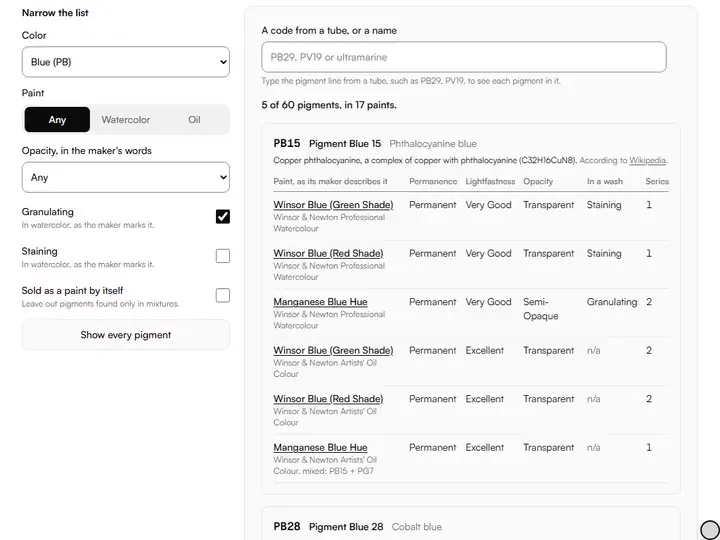
- PB15Pigment Blue 15Phthalocyanine blue
Copper phthalocyanine, a complex of copper with phthalocyanine (C32H16CuN8). According to Wikipedia.
Paint, as its maker describes it Permanence Lightfastness Opacity In a wash Series Winsor Blue (Green Shade)Winsor & Newton Professional Watercolour Permanent Very Good Transparent Staining 1 Winsor Blue (Red Shade)Winsor & Newton Professional Watercolour Permanent Very Good Transparent Staining 1 Manganese Blue HueWinsor & Newton Professional Watercolour Permanent Very Good Semi-Opaque Granulating 2 Winsor Blue (Green Shade)Winsor & Newton Artists' Oil Colour Permanent Excellent Transparent n/a 2 Winsor Blue (Red Shade)Winsor & Newton Artists' Oil Colour Permanent Excellent Transparent n/a 2 Manganese Blue HueWinsor & Newton Artists' Oil Colour, mixed: PB15 + PG7 Permanent Excellent Transparent n/a 1 - PB27Pigment Blue 27Prussian blue
A synthetic pigment made of iron and cyanide (C18Fe7N18). According to Wikipedia.
Paint, as its maker describes it Permanence Lightfastness Opacity In a wash Series Prussian BlueWinsor & Newton Professional Watercolour Permanent Excellent Transparent Staining 1 Antwerp BlueWinsor & Newton Professional Watercolour Permanent Excellent Transparent – 1 Prussian BlueWinsor & Newton Artists' Oil Colour Permanent Excellent Transparent n/a 1 - PB28Pigment Blue 28Cobalt blue
Cobalt(II) aluminate. According to Wikipedia.
Paint, as its maker describes it Permanence Lightfastness Opacity In a wash Series Cobalt BlueWinsor & Newton Professional Watercolour Extremely Permanent Excellent Semi-Transparent Granulating 4 Cobalt BlueWinsor & Newton Artists' Oil Colour Extremely Permanent Excellent Semi-Transparent n/a 4 Cobalt TurquoiseWinsor & Newton Professional Watercolour, mixed: PB28 + PB36 Extremely Permanent Excellent Semi-Opaque Granulating 4 Terre VerteWinsor & Newton Professional Watercolour, mixed: PB28 + PG23 Extremely Permanent Excellent Semi-Transparent Granulating 1 - PB29Pigment Blue 29Ultramarine
A sulfur-containing sodium aluminium silicate, made synthetically or found as a mineral. According to Wikipedia.
Paint, as its maker describes it Permanence Lightfastness Opacity In a wash Series French UltramarineWinsor & Newton Professional Watercolour Permanent Excellent Transparent Granulating 2 French UltramarineWinsor & Newton Artists' Oil Colour Permanent Excellent Transparent n/a 2 Ultramarine (Green Shade)Winsor & Newton Artists' Oil Colour Permanent Excellent Transparent n/a 1 - PB35Pigment Blue 35Cerulean blue
Cobalt(II) stannate. According to Wikipedia.
Paint, as its maker describes it Permanence Lightfastness Opacity In a wash Series Cerulean BlueWinsor & Newton Professional Watercolour Extremely Permanent Excellent Semi-Opaque Granulating 3 Cerulean BlueWinsor & Newton Artists' Oil Colour Extremely Permanent Excellent Semi-Opaque n/a 4 - PB36Pigment Blue 36
What this pigment is made of has not yet been read at a source, so it is not stated here.
Paint, as its maker describes it Permanence Lightfastness Opacity In a wash Series Cobalt TurquoiseWinsor & Newton Artists' Oil Colour Extremely Permanent Excellent Opaque n/a 5 Cobalt TurquoiseWinsor & Newton Professional Watercolour, mixed: PB28 + PB36 Extremely Permanent Excellent Semi-Opaque Granulating 4 - PB60Pigment Blue 60
What this pigment is made of has not yet been read at a source, so it is not stated here.
Paint, as its maker describes it Permanence Lightfastness Opacity In a wash Series Indanthrene BlueWinsor & Newton Professional Watercolour Permanent not stated Semi-Transparent – 3 Indanthrene BlueWinsor & Newton Artists' Oil Colour Permanent Excellent Transparent n/a 4 - PB74Pigment Blue 74
What this pigment is made of has not yet been read at a source, so it is not stated here.
Paint, as its maker describes it Permanence Lightfastness Opacity In a wash Series Cobalt Blue DeepWinsor & Newton Professional Watercolour Extremely Permanent not stated Semi-Transparent Granulating 4 Cobalt Blue DeepWinsor & Newton Artists' Oil Colour Extremely Permanent Very Good Semi-Transparent n/a 5 - PG7Pigment Green 7Phthalocyanine green
A complex of copper with chlorinated phthalocyanine (C32Cl16CuN8). According to Wikipedia.
Paint, as its maker describes it Permanence Lightfastness Opacity In a wash Series Winsor Green (Blue Shade)Winsor & Newton Professional Watercolour Permanent Excellent Transparent Staining 1 Winsor Green (Phthalo)Winsor & Newton Artists' Oil Colour Permanent Excellent Transparent n/a 2 Manganese Blue HueWinsor & Newton Artists' Oil Colour, mixed: PB15 + PG7 Permanent Excellent Transparent n/a 1 - PG17Pigment Green 17
What this pigment is made of has not yet been read at a source, so it is not stated here.
Paint, as its maker describes it Permanence Lightfastness Opacity In a wash Series Oxide of ChromiumWinsor & Newton Professional Watercolour Extremely Permanent Excellent Opaque Granulating, Staining 3 Oxide of ChromiumWinsor & Newton Artists' Oil Colour Extremely Permanent Excellent Opaque n/a 4 - PG18Pigment Green 18Viridian
Hydrated chromium(III) oxide. According to Wikipedia.
- PG23Pigment Green 23
What this pigment is made of has not yet been read at a source, so it is not stated here.
Paint, as its maker describes it Permanence Lightfastness Opacity In a wash Series Terre VerteWinsor & Newton Artists' Oil Colour Extremely Permanent Excellent Transparent n/a 1 Terre VerteWinsor & Newton Professional Watercolour, mixed: PB28 + PG23 Extremely Permanent Excellent Semi-Transparent Granulating 1
Every row is what the paint's own maker states on the page linked, read on 2026-10-09: Winsor & Newton Professional Watercolour and Winsor & Newton Artists' Oil Colour. The words are the maker's; another maker's paint from the same pigment can differ. A paint's series is its price band. This page gives no safety advice: read the label and the maker's safety sheet.
Every fact has a source.Each row links to the maker's page it was read on, with the date.
Read a tube's pigment line.Type PB29, PV19 and see each pigment in the mixture.
The maker's own words.Permanence, lightfastness and opacity as stated, not as we judge.
No account.A plain lookup. Nothing to sign up for, and nothing uploaded.
- Free
- No sign-up
- Runs entirely in your browser
What do the pigment codes on a paint tube mean?
The pigment codes on a paint tube, such as PB29, are Colour Index names. P stands for pigment, the letters for its color family (B for blue, R for red, Bk for black), and the number for its place in that family's list. PB29 is Pigment Blue 29, ultramarine. The code names the pigment whatever the paint is called.
How to use the Pigment Encyclopedia
The tool takes 6 steps, all on your device.
Find the pigment line on your tube: codes such as PB29 or PV19.
Type one or more codes, or a name, into the search box.
Read what each pigment is and the paints made with it.
Narrow the list by Color, Paint, Opacity, Granulating or Staining.
Follow a paint's link to its maker's own page.
Press Save these as text to keep the result with its sources.
What the Pigment Encyclopedia does
The Pigment Encyclopedia describes 60 pigments in 137 paints: single pigments and mixtures, granulating and staining, transparent to opaque.
60 pigments, 137 paints
Watercolor and oil. One of our color tools for artists.
Single pigments and mixtures
A mixed paint is listed under each pigment in it.
Granulating and staining
For watercolor, as the maker marks each paint.
Transparent to opaque
Filter by the maker's four steps of opacity.
What it is made of
The chemistry, where a source has been read; left blank where not.
Text and CSV
Save a search with its sources, or the whole table.
For painters who read the label
Watercolorists, oil painters, students and teachers read the pigment code on a label with it.
Watercolorists
Find which pigments granulate and which stain before a wash goes wrong.
Oil painters
Check a color's opacity for glazing, and its lightfastness for work that must last.
Students and teachers
See that two paints with different names can be one pigment.
Why does the code matter more than the name?
The code matters more than the name because paint names are a maker's choice. The same pigment is sold as Winsor & Newton's French Ultramarine and as another maker's Ultramarine Blue, and two paints both called a kind of red can hold quite different ones. The pigment code on the tube settles it. This page is one of our color tools for artists, and it starts from the code.
A code belongs to the Colour Index, a reference list of colorants kept by two trade bodies of dyers and colorists. A name in it is made of the kind of colorant, its hue and a number. On paint tubes the kind is nearly always P, for pigment.
What is shown, and where it comes from
Each pigment has its code, the code spelled out, and the paints made with it. For each paint the page gives what its maker states: permanence, lightfastness, opacity, whether it granulates or stains in watercolor, and its series, which is its price band. The paint's name links to the maker's own page, and the date it was read is at the foot.
The words are the maker's. Extremely Permanent, Excellent and Semi-Opaque are the terms printed on that page, and they are not turned into a score. Where a page does not state something, the row says not stated.
What a pigment is made of is shown only where a source was opened and read, with a link. Where that has not been done, the page says so and gives nothing.
One pigment, different paints
The same pigment can behave differently from one paint to the next. Opacity depends on the binder as well as the pigment: the page shows a pigment called semi-opaque in watercolor and opaque in oil. Makers grind and load their paints differently, and they rate them by their own tests.
So read a row as a statement about that paint. It is good evidence about the pigment and not a law. To see how two tube colors mix, use the paint mixing simulator.
Using it at the easel
For a wash that settles into the paper's tooth, turn on Granulating. For a color that will lift back off the paper, avoid Staining. For glazing in oil, set Paint to Oil and Opacity to Transparent. For a picture meant to last, look at the lightfastness of every pigment in a mixed paint, since the weakest one decides.
A mixed paint is listed under each of its pigments, marked as mixed, with the full pigment line. Turn on Sold as a paint by itself to hide pigments that appear only in mixtures.
What it leaves out
It holds the paints of the ranges read so far, and no others. A code that is missing is not a bad pigment; no maker's page for it has been read yet. It shows no color swatches, because a screen color for a pigment would be our guess.
It gives no safety advice. Some pigments are hazardous if swallowed or breathed as dust. Read the label on the tube and the maker's safety data sheet.
Further reading
The page below goes further into the ideas the Pigment Encyclopedia works with, and opens on the site named beside it.
- Drawing lessons on Artistic Masterclass (ArtisticMasterclass.com)
Tips from a working artist
From Sujith Puthran, artist and founder: what I actually do at the easel.
I read the pigment line before the name. If a new color is two pigments I already own, I mix it myself and save the money.
For watercolor skies I keep one granulating blue and one that does not granulate. The search tells me which is which in a minute.
Questions about the Pigment Encyclopedia
The 6 questions below cover pigment codes, single-pigment paints, granulation and lightfastness, then missing pigments and cost.
Pigment codes
What does PB29 mean?
PB29 is Pigment Blue 29 in the Colour Index, the pigment sold as ultramarine. P is for pigment, B for blue and 29 is its number in the list of blues.
What is a single-pigment paint?
A paint made from one pigment, so its tube shows one code. Single-pigment paints tend to make cleaner mixtures than paints that are already a mixture of several.
What does granulating mean in watercolor?
Granulating in watercolor means that a paint's pigment settles unevenly as a wash dries, gathering in the hollows of the paper and leaving a grainy texture. The page marks the paints their maker lists as granulating.
Is a paint marked permanent also lightfast?
Not always: a paint marked permanent is not called lightfast in the same words. This maker states permanence and lightfastness separately, and the page shows both as given. Check both for work that will be displayed in light.
Using the page
Why is my pigment not here?
Your pigment is not here when no paint range read so far uses it: only pigments used in the paint ranges read so far are listed. Nothing is shown for a pigment until a maker's page for it has been read, so the list grows range by range.
Is the Pigment Encyclopedia free?
Yes, the Pigment Encyclopedia is free, with no account. The table can be saved as a CSV file.
- The maker's pages; what a pigment is; the Colour Index: winsornewton.com/…/professional-watercolour-french-ultramarine · checked 2026-10-09
- The maker's pages; what a pigment is; the Colour Index: en.wikipedia.org/wiki/List_of_inorganic_pigments · checked 2026-10-09
- The maker's pages; what a pigment is; the Colour Index: winsornewton.com/products/artists-oil-colour-french-ultramarine · checked 2026-10-09
- The maker's pages; what a pigment is; the Colour Index: en.wikipedia.org/wiki/Phthalocyanine_Blue_BN · checked 2026-10-09
- The maker's pages; what a pigment is; the Colour Index: en.wikipedia.org/wiki/Phthalocyanine_Green_G · checked 2026-10-09
- The maker's pages; what a pigment is; the Colour Index: en.wikipedia.org/wiki/Quinacridone · checked 2026-10-09
- The maker's pages; what a pigment is; the Colour Index: en.wikipedia.org/wiki/Iron(III)_oxide · checked 2026-10-09
- The maker's pages; what a pigment is; the Colour Index: en.wikipedia.org/wiki/Bone_char · checked 2026-10-09
Type a pigment code and see what is behind it.
Free · No sign-up · Runs in your browser