Free Proportion Drill
How to improve drawing proportions: find out which way your eye is out. Five short tasks ask you to compare lengths, mark a midpoint, read an angle, judge plumb and level, and size up a shape. Each answer is checked against the measurements the figure was drawn from. Exports CSV. Free, with no sign-up, and it runs in your browser.
All five tasks, mixed. Every figure is drawn from known measurements, so each answer can be scored exactly: lengths in percent, angles in degrees, with the direction you were out. Every task works from the keyboard. Nothing is uploaded.
A lean is called once a group has 5 answers: upright against level lines, marks on level and upright lines, angles, plumb, level, and width against height. Sessions add up here.
Exact answers.Every figure is drawn from known numbers, so the truth is computed, never estimated from pixels.
Signed errors.Too long or too short, too far left or right, too flat or too upright: each answer keeps its direction.
Works from the keyboard.Every task is a slider. Arrow keys move it, Enter answers, and focus follows the work.
Repeatable.A session code brings the same figures back on any device. Nothing is uploaded.
- Free
- No sign-up
- Runs entirely in your browser
What is a proportion drawing exercise?
A proportion drawing exercise is practice at judging sizes and angles by eye before measuring them: how many times one length goes into another, where the middle of a line falls, how far a line tilts from the plumb. The judgement is then checked against a measurement, so the eye learns from its own errors.
How to use the Proportion Drill
The tool takes 6 steps, all on your device.
Choose which Tasks to include and how many Answers in a session.
Choose whether angles are answered In degrees or On the clock.
Choose Start session.
Read the question over the slider, move the slider with the pointer or the arrow keys, and choose Answer or press Enter.
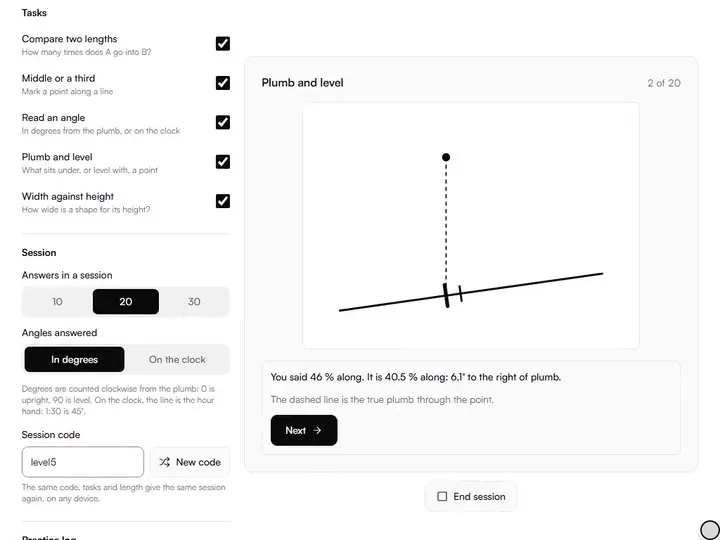
Look at the figure: the true place is drawn in, and the line under it says how far out you were and which way.
Choose Next, and at the end read Which way you lean.
What the Proportion Drill does
The Proportion Drill trains six judgements: comparative measuring, upright against level, middle and thirds, clock angles, plumb and level, and width against height.
Comparative measuring
Among the drawing practice tools, this one trains the measurement behind every block-in: how many times A goes into B.
Upright against level
Half the comparisons set an upright line against a level one, and the drill reports whether you read uprights long.
Middle and thirds
Slide a mark to the middle of a line, or a third of the way along. The true place is drawn beside yours.
Angles on the clock
Answer a tilt in degrees from the plumb, or as the hour hand of a clock: 1:30 is 45 degrees.
Plumb and level
Find what sits straight under a point, or level with it, on a sloping line.
Width against height
Say how wide a box, an oval, a triangle or an irregular shape is for its height.
How it compares with eye-training games
Each was played in a browser on 2 October 2026. Only what was seen is stated.
| Feature | This tool | The Eyeballing Game | Guess the Angle |
|---|---|---|---|
| Tasks | Length ratio, middle or third, angle, plumb and level, width against height | Parallelogram, midpoint, bisect angle, triangle center, circle center, right angle, convergence | Name one angle |
| Words for which way you were out | Yes | Not in its read-out | Higher or lower |
| A lean worked out across answers | Yes | No | No |
| Works from the keyboard | Yes | No | Type a number |
| How a result is given | Percent or degrees, per answer and per group | An inaccuracy figure per category, an average and a time | Degrees off, over six tries |
| Leaderboard | No | Yes | No |
| Other servers the page contacted | None | 11 | 14 |
The Eyeballing Game tests constructions this drill does not, such as finding a circle's center. It is played by dragging on a canvas; pressing Tab moved past it.
For anyone drawing from observation
Atelier students, portrait and figure artists and teachers drill the judgements that drawing from observation rests on.
Atelier students
Warm up the comparative eye before a cast or figure session.
Portrait and figure artists
Find the habit behind a likeness that keeps going wrong: long uprights, flat angles, a drifting plumb.
Teachers
Give a class one session code and compare how everyone read the same twenty figures.
Drawing proportion practice that measures the eye, not the drawing
Most advice on proportion is about checking a drawing: hold out a pencil, compare, correct. That checking is slow, and it is only needed because the first judgement was out. This drill works on the first judgement. You look, you commit to a number or a place, and the figure shows you the truth.
After a few sessions the errors stop looking random. A direction shows up: in how you read an upright line against a level one, or where you put a midpoint. Once you know yours, you know which way to distrust your eye. To check a finished drawing against its reference, use the drawing accuracy checker.
The five tasks
Compare two lengths shows lines A and B and asks how many times A goes into B, from 0.3 to 3 in steps of 0.05. Middle or a third puts a mark on a line for you to slide to the middle, or to one third of the way from the end marked A. Read an angle shows a slanting line. Plumb and level shows a point and a sloping line, and you slide a mark along the line until it sits straight under the point, or level with it. Width against height shows a shape and asks how wide it is for its height.
Lengths are scored in percent of the true length, marks in percent of the line, and angles in degrees.
Measuring by eye practice, in the studio's own terms
Angles are counted clockwise from the plumb, the vertical a weighted string gives: 0 is upright and 90 is level. The clock setting reads the same line as an hour hand, in steps of five minutes. These are the terms of the plumb line and angle measurer, which takes the same readings from a photo of your subject.
When the drill calls a lean
Answers are grouped by what they test: like lines compared, upright against level, marks on level and on upright lines, angles, plumb, level, and shapes. A group gets a sentence such as “You read upright lines 6.8 % longer than level ones” only when it has five answers or more, the average is at least 2 % or 1 degree, and it is at least twice its own standard error. That rule is this tool's own. One session rarely fills every group, so the first screen pools your last ten.
What it leaves out
The drill has no levels, lives or leaderboards, and no clock on an answer. Its figures are lines and plain shapes; it does not ask about photographs, casts or the figure, because their true measurements would have to be estimated. It does not look at your drawing. A phone held at an angle changes what upright means on the screen, so keep it square to you.
Further reading
The page below goes further into the ideas the Proportion Drill works with, and opens on the site named beside it.
- Drawing and painting lessons on Artistic Masterclass (ArtisticMasterclass.com)
Tips from a working artist
From Sujith Puthran, artist and founder: what I actually do at the easel.
I answer fast, then look hard at the correction. The first glance is the thing I am training.
Before a portrait session I run the tasks I am worst at, with the others switched off.
Questions about the Proportion Drill
The 6 questions below cover proportions, angle estimation, drawing from life and the plain figures, then your data and the practice log.
The drill
How do I improve my drawing proportions?
To improve your drawing proportions, compare before you draw: pick one length as a unit, judge every other length and angle against it, then check. Drilling the judgement on its own, as here, makes the checks smaller and fewer.
Is this angle estimation practice?
Yes, partly: one of the five tasks is angle estimation practice. It shows a slanting line and asks for its angle from the plumb, in degrees or as a clock reading, and scores you in degrees.
Can it train my eye for drawing from life?
Yes, partly: it can train your eye in the judgements drawing from life depends on, which are relative length, angle, plumb and level. It cannot replace drawing from a real subject, where those judgements have to be made on a form in space.
Why are the figures only lines and shapes?
The figures are only lines and shapes because their measurements are known exactly. A photograph would need its true lengths estimated, and the drill would then be scoring you against a guess.
Your data
Does the Proportion Drill upload anything?
No, the Proportion Drill does not upload anything. The figures are drawn in the page, your results stay in this browser, and the page contacts no other server.
Can the drill add to my practice log?
Yes, once you turn on Add sessions to my practice log. It is off until you turn it on.
Twenty figures, each answered by eye and checked against its own measurements.
Free · No sign-up · Runs in your browser